Tula means balance: keeping what your benefits cost level with what they're worth to your people. Independent of insurers, built on your own claims data, and planned three to five years ahead.
A package that hires and keeps people, and a renewal you can explain to your CFO.
India built to the same standard as your other markets, with the local detail right.
Market-entry firms, EOR providers and HR consultants who want a benefits specialist for India clients.
Two situations I'm asked about most
Hiring your first people in India, opening a Global Capability Centre, or moving staff off an Employer of Record.
What to offer, what to budget, who runs it → Running a programmeThe programme is in place, but renewals keep rising faster than anyone can explain.
What's driving cost, and what to change →Design, network, awareness, money leaking out, or all four? Tap the ones you suspect and I'll show you where I'd look first.
Usually it's more than one. I help you identify the gaps, and which ones are worth fixing first.
Tap each one.
Medical costs in India rise by about 10% a year. A design that looks cheap this year can be unaffordable in three. I cost every option over three to five years.
Parents' cover, top-ups and extras can be paid by employees at group rates. Done well, people get more cover, and your cost stays predictable.
Cataract surgery, chemotherapy and dialysis now take a few hours. Good design covers day-care treatment in full and makes it cashless.
Give employees a fixed amount to spend on what fits their life: parents' cover, outpatient care, wellbeing or a higher sum insured.
Outpatient and teleconsults, mental health, fertility treatment and preventive health checks. Small in cost, big in how people feel about the programme.
Tap a card to turn it over.
I work alongside your broker, insurer and TPA. They place the cover and handle claims. I make sure what you buy fits your people and your budget, and keeps fitting.
What similar employers in your sector and city offer.
Cover sized to your people and budget, with the trade-offs set out.
Alongside your broker: what to ask insurers for and how to read the quotes.
Cover in force before people join, matching the design.
Every 3 to 6 months, what I advised checked against your claims.
I don't disappear after the advice. Every three to six months I check what I recommended against what's actually happening in your claims and with your people, so any change is made well before renewal.
Three ways to work with me
A fixed-scope look at your claims and design. You get the cost drivers, a TPA review and fixes in order of impact.
Before renewal. You get a brief built on your data, a reading of the quotes, and what's worth negotiating.
For a new entity or a redesign. You get a benchmark, a recommended design with two alternatives, and cost per employee.
If your broker's analysis already explains your renewal, you may not. I'm useful when it doesn't. I look three to five years ahead, between renewals as well as at them, and I don't earn anything from which insurer you choose. I'm glad to work with your broker in the room.
I don't service your employees. Your TPA, insurer and broker do that, and they're good at it. I make sure the design is right, and every three to six months I check it's still working.
Published market surveys, IRDAI and insurer data, and what I've seen across the market over the years. I'll always tell you which is which, how recent it is, and where it doesn't match your situation.
No, and be careful of anyone who does. Claims move from year to year. What I can give you is the options, what each is likely to cost over three to five years, and the trade-offs, so the decision is yours and well informed.
Every recommendation comes with its assumptions and alternatives written down, so you can see why I said it and test it yourself. We review it every three to six months, so a wrong turn gets caught early, not at renewal.
You do. My fee is agreed with you before any work starts. If anyone else is involved in an engagement, I'll tell you in writing.
Figures from India's insurance regulator, IRDAI, and from published medical trend surveys. They explain why a benefits programme in India needs a plan for several years, not a price for one.
Compared with a premium that rises with India's projected medical cost trend (about 10% a year). An illustration, not a quote.
Projected employer medical cost trend in India, against the renewal increases employers typically see.
Medical trend: Aon Global Medical Trend Rates reports, India gross trend (2025, 2026 and 2027 editions). Renewal range: the author's experience with large employers.
Share of India's health insurance premium written through group policies, FY 2024-25.
Source: IRDAI Annual Report 2024-25, Table I.26 (health insurance excluding travel and personal accident). 1 crore = 10 million; ₹61,435 crore is about ₹614 billion.
Growth in premium and in commission paid to distributors, FY 2022-23 to FY 2024-25.
Source: IRDAI consultation paper, Recalibrating Economics of Insurance Distribution, 23 September 2026 (life figures: Part 1, para 43, a sample covering about 92% of corporate agency premium); broker figures as summarised by CareEdge Ratings, October 2026.
Average commission today, and the cap IRDAI has proposed for employer group health, as a share of premium.
Source: IRDAI consultation paper, 23 September 2026 (averages: Part 2, para 2.1.6; cap: Part 1, Box 4A, 5% for agents). The paper also notes one insurer paid a distributor as much as 93% on group health. These are proposals; revised guidelines are expected in December 2026, with a start date of 1 April 2027.
A 14-page guide for HR, Reward and Finance teams renewing on 31 March. What I would look at before signing, in the order I would look at it.
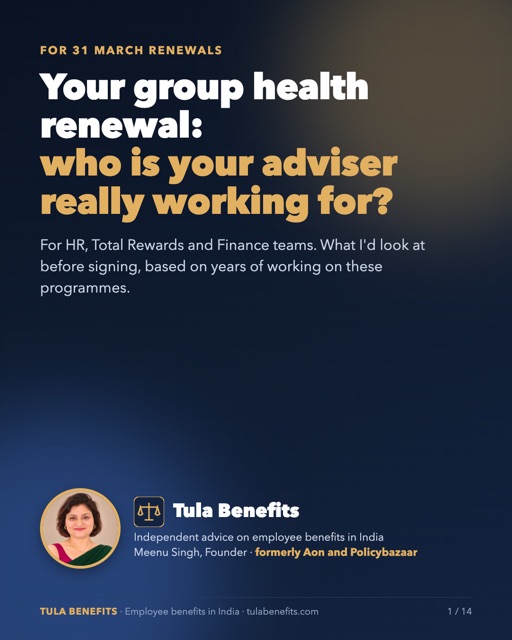
Practical notes for employers on Indian group health and the regulatory changes ahead. Read them here in full.
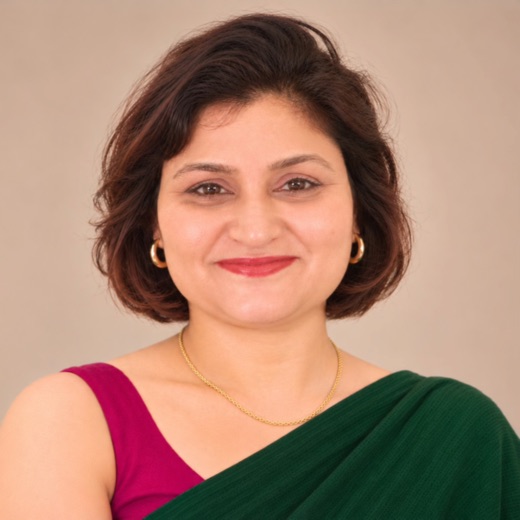
Most recently I was Vice President, Business Development (Employee Benefits), at Aon in India. I advised large IT, consulting and Global Capability Centre employers on health and life cover, flexible benefits, wellbeing, rewards, gratuity and pensions, including new entities set up through expansion partners. My part was to understand what each employer needed, shape the solution, and lead the conversations with insurers, working with specialist colleagues on claims analysis, underwriting and placement.
Before that I spent eight years at Policybazaar, one of India's largest online insurance marketplaces, where I set up its corporate insurance broking business from scratch.
I now run Tula Benefits, my independent practice. Tula is Sanskrit for balance: the balance between what benefits cost and what they are worth to people. With Tula, the person who designs the programme is the person who stays with it.
Speak to me to know what I can actually do for your programme.
Gurugram, India.
Available for calls during UK and European working hours.
 Tula Benefits